Sees what air defense cannot
Long-wave radars treat plastic and composite airframes as transparent. W-band millimetre waves reflect off them, resolving the smallest UAVs at extreme low altitude.
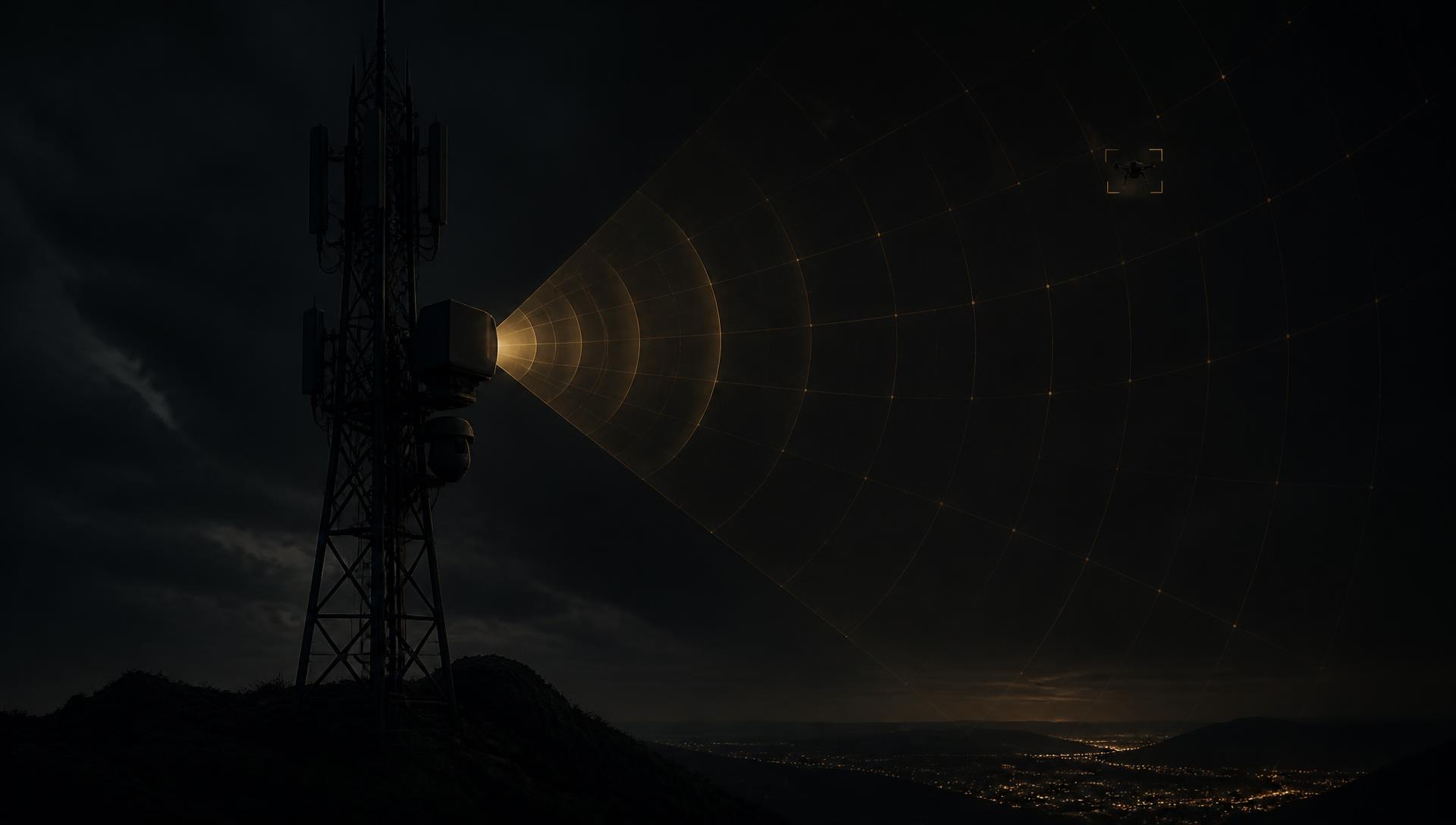

Distributed air defense · Counter-UAS
TRIADX develops millimetre-wave sensing, ultra-precise rotary platforms and the algorithmic layer that fuses them into a networked response to low-flying unmanned threats.
Thesis
Million-dollar interceptors cannot answer mass-produced drones. Our answer is detection-first, distributed and priced against the threat.
Long-wave radars treat plastic and composite airframes as transparent. W-band millimetre waves reflect off them, resolving the smallest UAVs at extreme low altitude.
Ground radars are bounded by relief and earth curvature. Sensors lifted to 30–50 m on existing towers expand the field of view exponentially and erase low-altitude blind spots.
Cellular base stations supply the mast, the fibre backhaul and uninterruptible power. Zero field communications deployment — a continuous radar field over existing footprint.
Sensor node
A compact 4D W-band radar that works where optics degrade — night, dust, fog and difficult lighting. More than a sensor: a controlled stack with operator GUI, replay, structured evidence and PTZ cueing.
W-band, 77–80 GHz
RadarActuation
A dual-axis platform precise enough to slave directly to radar coordinates. Open architecture allows fully autonomous target tracking, bypassing human reaction time.
±0.005° — under 25 arc seconds, backlash-free gearboxes
PlatformAlgorithmic unity
A finite state machine predicts trajectory and hands the target from tower to tower over fibre, holding the lock across the whole network.
A single continuous sensor field commands and coordinates all four echelons simultaneously — thousands of dollars per engagement instead of millions per shot.
Network · Echelons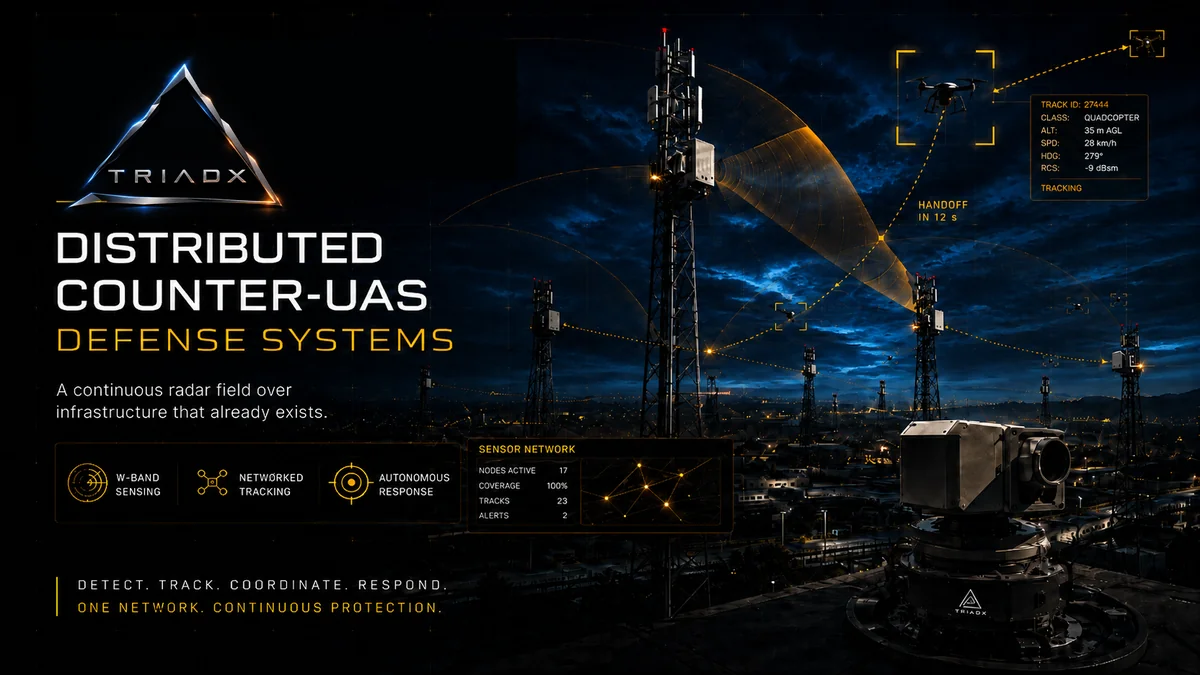
Deployment
No new towers, no new cable. Start with a single pilot node — radar, PTZ, Jetson and operator GUI — measured on false alarms per hour, detection continuity, target-to-camera latency and reacquisition after loss.
Technical briefing
Leave your work email and get the full presentation of the W-band radar sensing system — architecture, ROS2 stack and pilot metrics.